
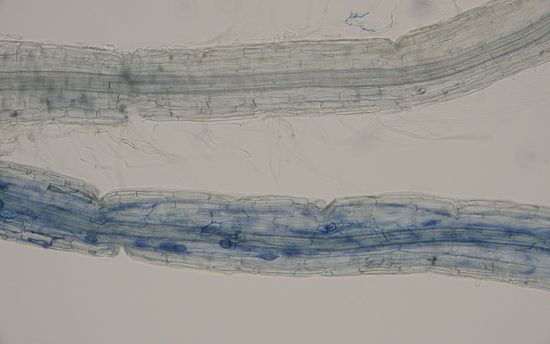
"Non-colonised (top) and colonised (bottom) roots of the same wheat plant. Mycorrhizal structures are stained in blue." photographer Ignacio Romero Lonzano, FiBL
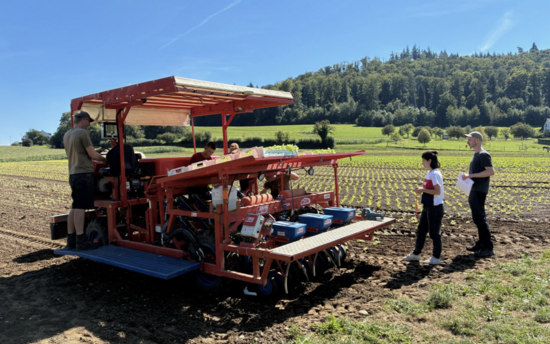
"On-farm experiment" photographer Natacha Bodenhausen, FiBL
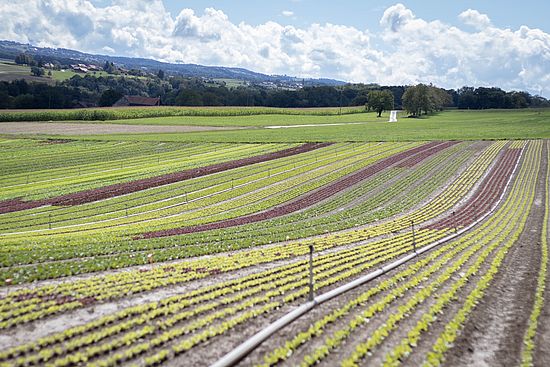
"Field experiment with lettuce to test new biocontrol product" photographer Giulia Capella, FiBL
Microbiome for a sustainable agriculture
Plant-microbe interactions
Research focus
The soil microbiome plays a central role for plant health and plant growth. A key objective of sustainable agriculture is to reduce inputs and instead harness the potential of soil microbial communities. A wide range of management practices can be used to influence the soil microbiome. Reduced soil disturbance, such as low or no-tillage, promotes symbiotic organisms like arbuscular mycorrhizal fungi (AMF), while mulching protects the soil surface and helps reduce erosion. Increasing plant diversity, through intercropping or agroforestry, further enhances microbial diversity and activity. Plant genetics also shape microbial associations, with certain genotypes being more effectively colonized by beneficial microorganism. In addition, direct inoculation of soils or seeds with microbial consortia offers a complementary strategy to promote plant-microbe interactions.
Our research group investigates these different levers for managing the soil microbiome. We study how vitiforestry system influence soil microbial diversity and function, with a particular focus on AMF. We are also developing a novel biocontrol agent against fungal diseases consisting of a consortium of bacteria and fungi, leveraging the ability of fungal hyphae to create networks that facilitate bacterial movement through heterogenous soils. In parallel, we are developing tools to quantify AMF abundance in plant roots. Understanding both the abundance and the composition of microbial community is essential, as these factors strongly determine their contribution to plant nutrition and plant health.
Research topics
Plant microbiome
Soil microbiome
Arbuscular mycorrhiza fungi
Dr. Natacha Bodenhausen
Research Institute of Organic Agriculture FiBL
Departement of Soil Sciences
Tel: +41 62 865 72 99
Interdisciplinary
Sustainable agriculture
Microbial ecology
Plant-microbe interactions
Tools to measure microbial diversity and abundance.
Development of biocontrol of fungal diseases
On-farm experiments